
Introduction – Theoretical and Conceptual Frameworks
“Paradigms and worldviews of nursing are subtle and powerful, reflecting different values and beliefs about the nature of human beings, human–environment relationships, health, and caring.” (Smith & Parker, 2014, p. 10)
Learning Objectives
In this chapter, we will explore how worldviews, frameworks, theories, concepts, and variables shape the research process.
By the end of this section, you will be able to:
- Define key concepts in the philosophy of science.
- Identify and differentiate between theoretical/empirical, aesthetic, personal, sociopolitical, and ethical ways of knowing.
- Identify assumptions underlying the post-positivist, critical social, and interpretive/constructivist research views.
- Compare inductive and deductive reasoning.
- Differentiate between conceptual and operational definitions.
- Describe the relationships between theory, research, and practice.
- Discuss levels of abstraction related to frameworks guiding research.
- Describe the points of critical appraisal used to evaluate the appropriateness, cohesiveness, and consistency of a framework guiding research.
Welcome to Chapter 2: Theoretical and Conceptual Frameworks
Welcome! As you continue your journey into nursing research, you’ll begin exploring the ideas that shape how researchers think, ask questions, and generate knowledge. At first, terms like paradigms, theoretical frameworks, and ontology may seem abstract, but they provide the foundation for every research study. Understanding these concepts will help you see that research is not just about collecting data—it is also about understanding how we view the world, what we believe counts as knowledge, and how those beliefs influence the questions we ask and the methods we choose.
Throughout this chapter, we’ll explore the philosophy of science and introduce the key building blocks that guide nursing research, including worldviews (paradigms), theoretical and conceptual frameworks, theories, concepts, and variables. You’ll learn about the knowledge translation process, levels of abstraction, and how ideas move from broad concepts to measurable variables. We’ll examine the major research paradigms used in nursing—including post-positivism, constructivism, and critical theory—and discuss how each influences research design and interpretation. You’ll also explore inductive and deductive reasoning, compare conceptual and theoretical frameworks, and learn how theory, research, and practice are interconnected in evidence-informed nursing.
As you work through the chapter, you’ll notice that learning happens in a variety of ways. Alongside the core content, you’ll find real-world nursing scenarios, learning activities, videos, reflection questions, examples, diagrams, and my Dr. Fehr Tips to help connect these concepts to clinical practice. Don’t worry if some ideas seem challenging at first. Take your time, revisit the figures, and use the examples to help make sense of the relationships between theories, frameworks, and research. Like learning a new language, these concepts become clearer with practice.
My hope is that by the end of this chapter, you’ll recognize that every research study is built upon a way of thinking about the world. Understanding theoretical frameworks will help you become a more thoughtful consumer of research, a stronger critical thinker, and a nurse who can confidently connect theory to practice. Most importantly, I hope you’ll begin to appreciate that asking meaningful questions starts with understanding the lens through which we view healthcare, people, and the world around us.
Key Terms You’ll Use Throughout This Chapter regarding Philosophical Vocabulary (Terms about knowledge, theory, and worldviews)
Theoretical frameworks provide the foundation for every research study. As you read this chapter, you’ll encounter new language used to describe how researchers think about knowledge, reality, and the research process. Don’t worry if these terms feel unfamiliar at first, they will become clearer as you work through the chapter and revisit them throughout the rest of this textbook.
Aim of Inquiry: The overall purpose or goal of a research study. It describes what the researcher hopes to understand, explain, describe, or improve.
Concept: An abstract idea, characteristic, or phenomenon that helps describe or explain an aspect of the world, such as health, resilience, stigma, or compassion.
Conceptual Framework: A structure developed by the researcher that organizes key concepts and illustrates how they are expected to relate to one another within a study. It provides a roadmap for understanding the research problem and guiding the research process.
Constructivism: A research worldview that recognizes that people create meaning through their experiences and interactions. Constructivist researchers seek to understand how individuals interpret and make sense of their realities.
Context: The setting or environment in which a phenomenon occurs. Context may include social, cultural, political, organizational, or historical influences that shape people’s experiences.
Critical Social Theory: A research worldview that explores how power, inequality, and social structures influence people’s lives. Research guided by this perspective seeks to promote equity, social justice, and meaningful change.
Epistemology: The study of knowledge. Epistemology asks questions such as: What counts as knowledge? and How do we know what we know?
Method: The specific technique or tool used to collect or analyze data, such as interviews, surveys, focus groups, or observations.
Methodology: The overall approach or strategy that guides how research is conducted. It explains why particular methods are chosen and how they align with the research question and philosophical perspective.
Ontology: The study of reality or existence. Ontology asks questions such as: What is reality? and Can reality be understood in different ways?
Paradigm: A worldview or set of beliefs that shapes how researchers understand reality, knowledge, and the process of conducting research.
Philosophical Beliefs: The assumptions researchers hold about reality, knowledge, and how knowledge is created. These beliefs influence every stage of the research process.
Positivism: A philosophical worldview that assumes reality can be objectively measured and understood through observation, measurement, and scientific methods. Positivist research often emphasizes quantitative methods and hypothesis testing.
Post-positivism: A philosophical worldview that recognizes that reality can be studied scientifically, but also acknowledges that researchers cannot be completely objective. Multiple perspectives and imperfect knowledge are accepted.
Qualitative Research: A research approach that explores people’s experiences, meanings, perceptions, and social interactions using non-numerical data such as interviews, observations, or written narratives.
Quantitative Research: A research approach that collects and analyzes numerical data to examine relationships, measure variables, or test hypotheses.
Text: In qualitative research, text refers to written or spoken information collected during a study, such as interview transcripts, field notes, journals, or documents that are analyzed for meaning.
Theoretical Framework: A theory, or combination of theories, that provides the foundation for a research study and helps explain, predict, or interpret the phenomenon being investigated.
Theory: A set of interconnected concepts that explains, predicts, or describes relationships among phenomena.
Worldview: A person’s or researcher’s underlying beliefs about reality, knowledge, and how the world works. In research, worldview is often used interchangeably with the term paradigm.
Reminder: The key terms introduced at the beginning of this chapter will continue to appear throughout this section. As you read, revisit these definitions and consider how they connect to the examples, activities, and nursing scenarios presented.
The Knowledge Translation Framework
In order to conduct research and generate knowledge that can be used in practice, we must follow steps in the knowledge translation process. Knowledge development starts with identifying a knowledge gap, then generating knowledge, distributing knowledge, adopting knowledge, and reviewing and revising knowledge (see Figure 2.1). We will be referring to this model throughout this resource as we review different aspects of the research process.
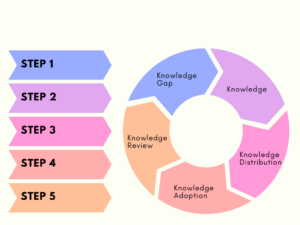
How do theoretical frameworks fit into this process? Theoretical frameworks play a role in framing what we know, what we can know, and how we can know it. Theoretical frameworks are useful at all stages of the knowledge development process, but they are especially important during the knowledge generation stage. They help researchers form a clear and focused research question and provide a conceptual lens to analyze existing literature. Theoretical frameworks also provide direction for research by establishing the foundation on which the study is built.
To help understand what a paradigm or theoretical framework is in the context of nursing, consider the evolving perspectives on medical assistance in dying (MAiD). In the past, the idea of intentionally ending a person’s life, even to relieve suffering, was largely viewed as incompatible with the values of nursing, which emphasize preserving life, providing comfort, and promoting healing. Many nurses saw MAiD as ethically unacceptable and outside the scope of compassionate care. However, as societal attitudes have shifted and legislation has changed, so too have nursing perspectives. In countries like Canada, where MAiD is now legally permitted, nursing has had to respond with new ethical frameworks, professional guidelines, and educational supports. Today, some nurses see MAiD as an extension of patient-centered care—one that respects autonomy and supports dignity at the end of life. The nursing profession remains divided, with some practitioners fully embracing MAiD and others conscientiously objecting. These differing perspectives reflect underlying paradigms—deeply held beliefs about life, death, suffering, and the role of the nurse. The change in how MAiD is viewed demonstrates how paradigms can evolve in response to new social, legal, and clinical realities.
Learning Activity
Applying the 5 Steps of the Nursing Research Process
Nursing research follows a systematic process that helps researchers move from identifying a clinical issue to applying evidence in practice. Understanding each step of the research process helps nurses critically evaluate evidence and participate in evidence-informed care. This activity will help students apply the 5 steps of the nursing research process using a real-world clinical example.
Case Scenario
Nurses working on a medical-surgical unit notice that many older adult patients report poor sleep during hospitalization. Staff members observe that disrupted sleep may contribute to increased confusion, fatigue, irritability, and delayed recovery.
The nursing team is interested in exploring whether implementing a nighttime quiet protocol could improve patient sleep quality.
The 5 Steps of the Nursing Research Process
Step 1: Identify the Problem
Researchers begin by recognizing a clinical issue, concern, or gap in practice.
Example:
Older adult patients report poor sleep during hospitalization.
Step 2: Review Existing Knowledge
Researchers examine existing literature and evidence to better understand what is already known about the issue.
Example:
The nursing team reviews studies on hospital noise, sleep disruption, and patient recovery outcomes.
Step 3: Develop a Research Question
Researchers create a focused question that guides the study.
Example Research Question:
Does implementing a nighttime quiet protocol improve sleep quality in hospitalized older adults?
Step 4: Design and Conduct the Study
Researchers select an appropriate research design and collect data.
Example:
The unit introduces quiet hours, dims hallway lights, and reduces overnight interruptions for four weeks. Patients complete a short sleep-quality survey before discharge.
Step 5: Analyze Findings and Apply Knowledge
Researchers interpret findings and consider how results may improve nursing practice.
Example:
Patients report improved sleep quality following implementation of the quiet protocol. The unit considers adopting the protocol permanently.
Student Activity
Using the case scenario above, answer the following questions:
1. Why is identifying a clinical problem an important first step in nursing research?
2. What types of information might researchers look for during the literature review stage?
3. Is the example research question broad or focused? How could it be improved?
4. What type of data might be collected in this study?
5. How could the findings influence nursing practice or patient care?
Extension Activity (Optional)
Working individually or in pairs, create your own brief clinical scenario and map it through the 5 steps of the nursing research process.
Key Takeaway
Nursing research begins with real clinical questions and concerns. By following a structured research process, nurses can contribute to evidence-informed practice and improve patient outcomes.
Remixed from:
- An Introduction to Research Methods in Sociology by Valerie Shepard (2019), published by Justice Institute of British Columbia and BCcampus, using a CC-BY-NC-SA 4.0 license.
Media Attribution
- Figure 2.1 Knowledge Translation Framework made on Canva by Katie Gregson subject to Canva Content License is adapted from content in Haber et al. (2022, p. 21.), used under fair dealing for education and non-commercial purposes.
References
Haber, J., Cameron, C., Singh, M. D., & Lobiondo-Wood, G. (2022). Nursing research in Canada: Methods, critical appraisal, and utilization (5th ed.). Elsevier Canada. p. 21.
Sheppard, V. A. (2019). An introduction to research methods in sociology. Justice Institute of British Columbia/ BCcampus. https://pressbooks.bccampus.ca/researchmethods/chapter/research-paradigms-in-social-science/
Smith, M. J., & Parker, M. E. (2010). Nursing theories and nursing practice (3rd ed.) [PDF]. F.A. Davis. Retrieved from https://vdoc.pub/documents/nursing-theories-and-nursing-practice-third-edition-701hg7nain50
The goals or specific objectives of the research.
An abstract notion (for example: language, stigma, bullying).
A structure developed by the researcher that organizes key concepts and illustrates how they are expected to relate to one another within a study. It provides a roadmap for understanding the research problem and guiding the research process.
A worldview that holds that knowledge and meaning are created through human experience and social interaction.
The environment in which a phenomenon occurs (political, social, cultural, or institutional).
A research worldview that explores how power, inequality, and social structures influence people's lives. Research guided by this perspective seeks to promote equity, social justice, and meaningful change.
The study of knowledge; Addresses questions such as “What is truth?” and “How do we know what we know?”
The specific research tool used to collect data (e.g., survey, interview, focus groups).
Methodology: The means to obtaining knowledge; Principles, rules, and procedures that guide the process, an analysis of all methods and procedures of the investigation; Research methodology addresses the specific rules and procedures that guide the process through which knowledge will be acquired.
The study of “being”; Addresses questions such as, “What is reality?” and “What is true?”
A set of beliefs, assumptions, and practices that shapes how people understand, study, and interpret the world or a particular field of knowledge.
The assumptions researchers hold about reality, knowledge, and how knowledge is created. These beliefs influence every stage of the research process.
A philosophical worldview that assumes reality can be objectively measured and understood through observation, measurement, and scientific methods. Positivist research often emphasizes quantitative methods and hypothesis testing.
A research worldview that assumes reality exists but can never be fully known. Knowledge is considered approximate, and researchers use systematic, evidence-based methods to develop explanations while recognizing their own assumptions and the limitations of their findings.
A research approach that explores people's experiences, meanings, perceptions, and social interactions using non-numerical data such as interviews, observations, or written narratives.
A research approach that collects and analyzes numerical data to examine relationships, measure variables, or test hypotheses.
In qualitative research, text refers to written or spoken information collected during a study, such as interview transcripts, field notes, journals, or documents that are analyzed for meaning.
A theory, or combination of theories, that provides the foundation for a research study and helps explain, predict, or interpret the phenomenon being investigated.
A collection of explanations about a particular subject.
The lens through which people perceive, understand, and make sense of reality.
The theory or set of theories that provides the foundation for a study and helps explain, predict, and interpret the phenomenon being investigated.