
History of Nursing Research
Nursing research has evolved as a vital foundation for modern nursing practice, shaping the profession’s commitment to evidence-based care and improved patient outcomes. Its origins can be traced to the 19th century (See Figure 1.2), when Florence Nightingale used statistical analysis during the Crimean War to examine the impact of sanitation on mortality, laying the groundwork for systematic inquiry in nursing (Nightingale, 1859/1969; Williams, 2023). Although research activity remained limited in the early decades of the profession, the mid-20th century marked a significant turning point as nursing education shifted into academic settings and emphasized scientific investigation (University of Maryland School of Nursing, n.d.). From the 1960s onward, increasing recognition of the value of research, coupled with advances in graduate education, led to rapid growth in the discipline and the development of a distinct body of nursing knowledge (Burns & Grove, 2009). Today, nursing research encompasses diverse methodologies and interdisciplinary collaboration, supporting evidence-based practice by integrating the best available research with clinical expertise and patient values (Burns & Grove, 2009). Understanding this historical progression provides essential context for appreciating the current role of research in nursing and highlights the profession’s ongoing commitment to advancing knowledge and improving patient care.
Notable Contributors to Nursing Research
Nursing research has evolved through the dedication of influential thinkers who have shaped how nurses provide care, generate evidence, and improve health outcomes. The contributors below represent key figures—both historical and contemporary—whose work continues to guide nursing education, research, and practice today. See Figure 1.2 for a timeline on nursing research.
-
- Florence Nightingale – A pioneer in data-driven nursing research. During the Crimean War, she used statistical analysis to identify sanitation issues and significantly reduce mortality in military hospitals.
- Virginia Henderson – Advanced nursing theory and research by defining the nurse’s role in helping individuals achieve independence, and by compiling major indices of nursing literature.
- Madeleine Leininger – Introduced the field of transcultural nursing, developing the Theory of Culture Care Diversity & Universality, and guiding research on culturally congruent care.
- Dorothy Johnson – Developed the Behavioral System Model, focusing on human behavior systems and the nurse’s role in restoring balance; emphasized research-based nursing knowledge.
Modern and Contemporary Researchers
- Patricia Benner – A more modern example: her seminal work From Novice to Expert (1984) outlines the stages of clinical competence and has deeply influenced nursing education and research.
- Eugenia Millender – Specializes in health disparities and culturally sensitive care, with projects supporting indigenous and underserved communities.
-
Linda Aiken – Influential in public policy on nurse staffing, burnout, and nursing education
- Maureen Markle-Reid – Focuses on quality of life for older adults with multiple chronic conditions and caregiver support; holds a Canada Research Chair in Aging.
-
Sara Ling – Nurse scientist developing new scientist roles to bridge practice and research in addiction and mental health
Understanding How Nursing Knowledge Builds Over Time
Nursing research does not always involve creating entirely new knowledge. Much of the advancement in nursing science comes from refining, re-examining, and extending what is already known.
A helpful way to understand this is to imagine nursing knowledge as a ball of yarn. Each strand represents a study, theory, or clinical finding. Some strands are new, but many are extensions of earlier work that have been pulled forward, tightened, or reworked to better understand a specific issue.
Rather than starting from scratch each time, researchers often:
· explore existing concepts in new populations or settings
· refine earlier findings using new methods or data
· examine specific “threads” within a broader concept
· connect multiple strands to better understand complex health issues
In this way, nursing knowledge grows incrementally and cumulatively, rather than as isolated discoveries. Each study contributes to strengthening and reshaping the overall “ball of yarn” that represents the discipline.

Knowledge Building Pathway Activity
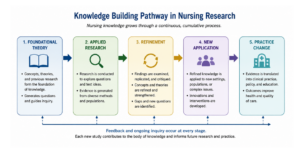
Knowledge Building Pathway Activity: Applying Foundational Theory to Practice Change
Case Study: Medical Cannabis as Adjunct Therapy in Chronic Pain Management
A community health clinic in Kamloops is seeing an increasing number of adults living with chronic non-cancer pain. Many clients have a history of long-term opioid use, unstable housing, and complex social determinants of health. Some clients have independently begun using medical cannabis as an adjunct therapy to help manage pain, sleep difficulties, anxiety, and overall quality of life.
Nurses working in the clinic report uncertainty about how to discuss medical cannabis in a consistent, evidence-informed, and nonjudgmental manner within care planning conversations.
Existing nursing approaches to chronic pain management and harm reduction emphasize:
· person-centred care
· understanding the lived experience of pain
· reducing harms associated with substance use
· collaborative decision-making between nurses and clients A nursing research team develops the following research question:
How do adults living with chronic pain perceive the use of medical cannabis as an adjunct therapy alongside conventional pain management strategies in a community health setting?
Applying the Knowledge Building Pathway
Using the Knowledge Building Pathway diagram presented earlier in this chapter, consider how this clinical issue moves from foundational theory to potential practice change.
1. Foundational Theory
· What nursing theories, concepts, or principles help explain this issue?
· How might harm reduction or person-cenetred care guide nursing practice?
2. Applied Research
· What type of research design could help answer this question?
· What information would researchers need to collect?
3. Refinement
· What gaps exist in current knowledge about medical cannabis and chronic pain?
· How might this research refine or expand current understanding?
4. New Application
· How could findings be applied within community nursing practice?
· What changes might occur in nursing assessments or patient education?
5. Practice Change
· How could research findings influence policies, guidelines, or nursing education?
· What might evidence-informed practice look like in this setting?
Reflection Question
Research in nursing does not always begin with discovering something entirely new. Often, it involves revisiting existing concepts, exploring lived experiences, and refining practice approaches to better meet patient and community needs.
In this case study, how does the Knowledge Building Pathway demonstrate the connection between nursing theory, research inquiry, and real-world practice change?
Media Attribution
- Figure 1.2 Timeline by Ime Stavinga & Dr. Florriann Fehr on Canva and is subject to the Canva Content License.
- Figure 1.3 Knowledge building pathway in nursing research is by Dr. Florriann Fehr and is subject to the CC BY-NC-SA 4.0 license.
Reference
Benner, P. From Novice to Expert: Excellence and Power in Clinical Nursing Practice. The American Journal of Nursing. 1984, 84 (12), 1479. https://doi.org/10.1097/00000446-198412000-00025
Burns, N., & Grove, S. K. (2009). The practice of nursing research: Appraisal, synthesis, and generation of evidence (6th ed.). Saunders Elsevier.
Nightingale, F. (1969). Notes on nursing: What it is, and what it is not. Dover. (Original work published 1859)
University of Maryland School of Nursing. (n.d.). History of nursing research. https://www.nursing.umaryland.edu/
Williams, R. (2023). The evolution of nursing: From Florence Nightingale to the present day. Journal of Intensive and Critical Care Nursing.