
Introduction – Theoretical Frameworks
“Paradigms and worldviews of nursing are subtle and powerful, reflecting different values and beliefs about the nature of human beings, human–environment relationships, health, and caring.” (Smith & Parker, 2014, p. 10)
Learning Objectives
In this chapter, we will explore how worldviews, frameworks, theories, concepts, and variables shape the research process.
By the end of this section, you will be able to:
- Define key concepts in the philosophy of science.
- Identify and differentiate between theoretical/empirical, aesthetic, personal, sociopolitical, and ethical ways of knowing.
- Identify assumptions underlying the post-positivist, critical social, and interpretive/constructivist research views.
- Compare inductive and deductive reasoning.
- Differentiate between conceptual and operational definitions.
- Describe the relationships between theory, research, and practice.
- Discuss levels of abstraction related to frameworks guiding research.
- Describe the points of critical appraisal used to evaluate the appropriateness, cohesiveness, and consistency of a framework guiding research.
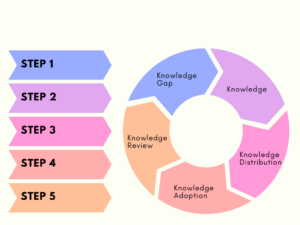
In order to conduct research and generate knowledge that can be used in practice, we must follow steps in the knowledge translation process. Knowledge development starts with identifying a knowledge gap, then generating knowledge, distributing knowledge, adopting knowledge, and reviewing and revising knowledge. We will be referring to this model throughout this resource as we review different aspects of the research process.
Here is a visual model of this knowledge translation process framework, adapted from Haber et al. (2022):
How do theoretical frameworks fit into this process? Theoretical frameworks play a role in framing what we know, what we can know, and how we can know it. Theoretical frameworks are useful at all stages of the knowledge development process, but they are especially important during the knowledge generation stage. They help researchers form a clear and focused research question and provide a conceptual lens to analyze existing literature. Theoretical frameworks also provide direction for research by establishing the foundation on which the study is built.
To help understand what a paradigm or theoretical framework is in the context of nursing, consider the evolving perspectives on medical assistance in dying (MAiD). In the past, the idea of intentionally ending a person’s life, even to relieve suffering, was largely viewed as incompatible with the values of nursing, which emphasize preserving life, providing comfort, and promoting healing. Many nurses saw MAiD as ethically unacceptable and outside the scope of compassionate care. However, as societal attitudes have shifted and legislation has changed, so too have nursing perspectives. In countries like Canada, where MAiD is now legally permitted, nursing has had to respond with new ethical frameworks, professional guidelines, and educational supports. Today, some nurses see MAiD as an extension of patient-centered care—one that respects autonomy and supports dignity at the end of life. The nursing profession remains divided, with some practitioners fully embracing MAiD and others conscientiously objecting. These differing perspectives reflect underlying paradigms—deeply held beliefs about life, death, suffering, and the role of the nurse. The change in how MAiD is viewed demonstrates how paradigms can evolve in response to new social, legal, and clinical realities.
Key Definitions
Here are some key definitions related to this topic:
- Theory: A collection of explanations about a particular subject.
- Concept: An abstract notion (for example: language, stigma, bullying).
- Ontology: The study of “being”; Addresses questions such as, “What is reality?” and “What is true?”
- Epistemology: The study of knowledge; Addresses questions such as “What is truth?” and “How do we know what we know?”
- Methodology: The means to obtaining knowledge; Principles, rules, and procedures that guide the process, an analysis of all methods and procedures of the investigation; Research methodology addresses the specific rules and procedures that guide the process through which knowledge will be acquired.
- Method: The specific research tool used to collect data (e.g., survey, interview, focus groups).
- Context: The environment in which a phenomenon occurs (political, social, cultural, or institutional).
- Aim of inquiry: The goals or specific objectives of the research.
- Researcher values: The personal beliefs and assumptions the researcher brings to the study.
Remixed from:
- An Introduction to Research Methods in Sociology by Valerie Shepard (2019), published by Justice Institute of British Columbia and BCcampus, using a CC-BY-NC-SA 4.0 license.
Media Attribution
- Figure 2.1 Knowledge Translation Framework made on Canva by Katie Gregson subject to Canva Content License is adapted from content in Haber et al. (2022, p. 21.), used under fair dealing for education and non-commercial purposes.
References
Haber, J., Cameron, C., Singh, M. D., & Lobiondo-Wood, G. (2022). Nursing research in Canada: Methods, critical appraisal, and utilization (5th ed.). Elsevier Canada. p. 21.
Sheppard, V. A. (2019). An introduction to research methods in sociology. Justice Institute of British Columbia/ BCcampus. https://pressbooks.bccampus.ca/researchmethods/chapter/research-paradigms-in-social-science/
Smith, M. J., & Parker, M. E. (2010). Nursing theories and nursing practice (3rd ed.) [PDF]. F.A. Davis. Retrieved from https://vdoc.pub/documents/nursing-theories-and-nursing-practice-third-edition-701hg7nain50
A collection of explanations about a particular subject.
An abstract notion (for example: language, stigma, bullying).
The study of “being”; Addresses questions such as, “What is reality?” and “What is true?”
The study of knowledge; Addresses questions such as “What is truth?” and “How do we know what we know?”
Methodology: The means to obtaining knowledge; Principles, rules, and procedures that guide the process, an analysis of all methods and procedures of the investigation; Research methodology addresses the specific rules and procedures that guide the process through which knowledge will be acquired.
The specific research tool used to collect data (e.g., survey, interview, focus groups).
The environment in which a phenomenon occurs (political, social, cultural, or institutional).
The goals or specific objectives of the research.
The personal beliefs and assumptions the researcher brings to the study.