
Research with Indigenous Populations
Background
Research involving Indigenous Peoples in Canada has historically been shaped by colonial systems that often excluded Indigenous voices, knowledge systems, and governance. In many cases, research was conducted on Indigenous communities rather than with them, resulting in mistrust, exploitation of data, and limited benefit to communities. Recognizing this legacy is essential for understanding contemporary Indigenous research methodologies. Truth-telling about colonial history, including residential schools, forced assimilation policies, and unethical research practices, is a necessary step toward reconciliation and ethical scholarship.
Indigenous research in Canada is increasingly guided by principles that emphasize relationship-building, community engagement, cultural safety, and respect for Indigenous knowledge systems. These approaches recognize that knowledge is not only intellectual but also relational, embodied, spiritual, and connected to land and community.
For nurses and health researchers, understanding Indigenous research methodologies is particularly important because research and evidence inform healthcare policies, programs, and interventions affecting Indigenous Peoples. Ethical research practices must therefore prioritize community benefit, cultural respect, and Indigenous self-determination.
Definition of Indigenous Research
Indigenous research refers to research that is conducted by, grounded in, or meaningfully engaged with First Nations, Inuit, and Métis communities, knowledge systems, cultures, and lived experiences. It may involve Indigenous researchers, community leadership, or collaborative partnerships between Indigenous and non-Indigenous scholars.
Unlike traditional Western research approaches that often prioritize objectivity and detachment, Indigenous research methodologies emphasize relational accountability, collective knowledge, and reciprocal relationships between researchers and communities.
There is a high risk of distress and re-traumatization through culturally unsafe and inappropriate research methodologies. There are also risks related to how data will be interpreted and disseminated, with or without community consultation. Data may be inappropriately interpreted if the community is not involved in its collection and analysis.
Be mindful of the principles of Indigenous data sovereignty—contributions by Indigenous people are not just data, they are stories. These principles can be found on the webpage of Maiam Nayri Wingara Communique (Maiam Nayri Wingara, n.d.). These principles assert that control and accountability of the data rest with First Peoples and, as such, data should be contextualized and made accessible at both an individual and community level. This approach is consistent with principles of self-determination. Culturally informed data management should be understood as a process that protects and respects both individual and collective interests. People who participate in one-to-one yarning sessions or yarning circles should be given the opportunity to indicate how they want their stories used, whether they wish to be named, and be informed of any other relevant contextual factors. This process upholds the participants’ rights to their stories.
First Nations peoples worldwide are over-researched, with research conducted to, or on, them rather than for and with them. Therefore, it is important that researchers work with First Nations communities, and that the research is initiated and led by the participating community to ensure it is relevant and beneficial. Community-Led Research—Walking New Pathways Together, by Rawlings, Flexner, and Riley (2021), provides guidance on building relationships and collaboration with communities, as well as following appropriate protocols.
Key Principles of Indigenous Research
Relational Accountability
Relationships are central to Indigenous research approaches. Researchers are accountable not only to participants but also to communities, land, culture, and future generations. Ethical research requires building trust, maintaining transparency, and respecting community governance structures.
For nursing researchers, this means engaging respectfully with community leaders, Elders, and Knowledge Keepers throughout the research process.
Community Benefit and Reciprocity
Indigenous research must provide meaningful benefits to the community involved. Historically, research often served academic or governmental interests rather than the needs of Indigenous communities. Ethical Indigenous research seeks to return knowledge, strengthen capacity, and support community priorities.
Reciprocity may include knowledge translation for communities, collaborative program development, or shared authorship in publications.
Cultural Safety and Trauma-Informed Approaches
Research with Indigenous communities must recognize the historical and ongoing impacts of colonialism, including intergenerational trauma, systemic racism, and cultural disruption. Researchers should adopt trauma-informed approaches that acknowledge historical harms while promoting healing and empowerment.
Cultural safety involves respecting cultural protocols, engaging Elders and Knowledge Keepers, and ensuring research practices align with community values.
Indigenous Data Sovereignty and OCAP®
Indigenous communities have the right to control how their data are collected, used, and shared. One widely recognized framework is OCAP®, which stands for:
- Ownership – Indigenous communities collectively own their information.
- Control – Communities control how research is conducted.
- Access – Communities have access to their own data.
- Possession – Communities maintain physical stewardship of data.
These principles support Indigenous self-determination and protect communities from exploitation or misuse of data.
The Five R’s of Indigenous Research
Many Indigenous scholars describe ethical Indigenous research using the Five R’s:
- Respect – Honour Indigenous cultures, traditions, and knowledge systems.
- Responsibility – Researchers are accountable for the impact of their work.
- Relevance – Research must address community priorities and concerns.
- Reciprocity – Knowledge sharing and mutual benefit are essential.
- Refusal – Communities have the right to decline research participation.
Common Indigenous Research Approaches
Community-Based Participatory Research (CBPR)
Community-Based Participatory Research is one of the most common Indigenous research approaches. CBPR involves community members as equal partners throughout the research process, including:
· Identifying research priorities
· Designing the study
· Collecting and interpreting data
· Disseminating findings
This approach strengthens community capacity and ensures research outcomes are meaningful and applicable.
Conversational and Story-Based Methods
Indigenous research often uses dialogue, storytelling, and sharing circles as methods of knowledge generation. These approaches recognize that stories are an important way of transmitting cultural knowledge and lived experience.
Story-based methods also support relational and culturally appropriate ways of sharing knowledge.
Embodied and Land-Based Knowledge
Some Indigenous methodologies recognize knowledge as embodied and experiential, meaning learning may occur through practices such as ceremony, art, dance, or land-based activities. These methods emphasize that knowledge is interconnected with identity, land, culture, and spirituality.
Ethical Guidelines for Indigenous Research in Canada
Research involving Indigenous Peoples in Canada must follow the Tri-Council Policy Statement: Ethical Conduct for Research Involving Humans (TCPS2), Chapter 9, which specifically addresses research with First Nations, Inuit, and Métis Peoples.
Key ethical expectations include:
· meaningful community engagement
· collaborative research design
· transparency and shared decision-making
· respect for Indigenous governance and protocols
· equitable distribution of research benefits
Researchers should also situate themselves within the research by reflecting on their own identity, positionality, and potential biases.
Intellectual Property (IP) and Challenges for Indigenous Peoples of Canada
The World Intellectual Property Organization (2017). Refers to “creations of the human mind”. These rights are the moral and economic rights to creations of knowledge and imagination and include the Copyright Act, the Patents Act, and the Trademarks Act. IP is often negotiated without consultation or accommodation of First Nations rights and often conflict with their principles. Canadian Intellectual Property rights are negotiated with international laws. The IP system allows others to use traditional laws and protocols as their own (take ownership) if they are the first to report information. According to the Copyright Act, others could potentially commercialize on other’s intellectual property without consent, especially if that intellectual property is not formally recognized or gone through an IP legal process. New ideas, products of research, and deliverables of research finding, trademarking of research might be vulnerable to being stolen by other researchers.
Fortunately, many Indigenous peoples have systems to protect their intellectual property rights: through laws imposed by various medicine societies, apprenticeship programs to teach new generations such as carvings and drumming and ultimately recognized through the United Nations Declaration on the Rights of Indigenous Peoples (UNDRIP), Article 31. UNDRIP Article 31 is very important in supporting Indigenous intellectual property systems, as this recognizes the rights of Indigenous peoples to maintain, control, protect and develop their own intellectual property. UNDRIP is an international, non-legally binding agreement that sets minimum standards for rights of Indigenous peoples and implicitly supports data sovereignty. The following figure demonstrates what needs to be acknowledged related to data sovereignty related to Indigenous peoples.
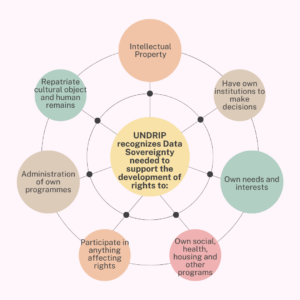
In order to follow the recommendations with UNDRIP, there needs to be free, prior, and informed consent with research. This means no coercion (free), consultation takes place before research decisions are made (prior), and the community is altered to the plans of the research and given sufficient information about the research so they understand the implications of the process to their rights and interests (informed). The UNDRIP documents can be found when searching, “UN Declaration on the Rights of Indigenous Peoples” or in the United Nations website related to research.
Reflection Questions to Consider
What are Canada’s commitments regarding First Nations peoples under UNDRIP?
Here are several Indigenous societies that protect the titles and rights of their communities, that can also relate to research processes and information management for Indigenous Communities across Canada since 2026:
- Council of Yukon First Nations: www.cyfn.ca
- Dene Nation: www.denenation.com
- First Nations Health Council (partner to First Nations Health Authority): www.fnhc.ca
- Alberta First Nations Information Governance Centre: www.afnigc.ca
- Federation of Sovereign Indigenous Nations: www.fsin.ca
- First Nations Health and Social Secretariat of Manitoba (FNHSSM): www.fnhssm.com
- Chiefs of Ontario: www.chiefs-of-ontario.org/
- Assembly of First Nations Quebec-Labrador: www.apnql.com/en
- First Nations Education Initiative Incorporated: www.fneii.ca
- Union of Nova Scotia Mi’kmaq: www.unsm.org
Conclusion
Indigenous research methodologies represent an important shift away from colonial research practices toward collaborative, respectful, and community-centered approaches. These methods recognize the value of Indigenous knowledge systems, relationships with land and community, and the importance of reciprocity in research.
For nurses and health researchers, applying Indigenous research principles is essential for advancing culturally safe and ethical healthcare research. By prioritizing relationship-building, community leadership, and Indigenous data sovereignty, research can contribute to health equity, reconciliation, and improved wellbeing for Indigenous Peoples in Canada.
Activity
Watch the video Navigating Traditional Knowledge and Intellectual Property [5:16] on YouTube, by World Intellectual Property Organization (WIPO) (2018).
 Note: If you are using a printed copy of this resource, watch the video by scanning the QR code with your mobile device.
Key Points Regarding Ethics and Indigenous Research
Indigenous research prioritizes relationships, respect, and community engagement.
Research should be conducted with Indigenous communities rather than on them.
Indigenous data sovereignty and OCAP® principles protect community control over information.
Ethical research requires cultural safety, trauma-informed practices, and collaboration with Elders and Knowledge Keepers.
Community-Based Participatory Research is a commonly used Indigenous research approach.
Activity
Reflection Questions specifically Regarding Indigenous Research:
Why is relational accountability important in Indigenous research?
How can nurses ensure their research benefits Indigenous communities?
What actions can researchers take to respect Indigenous data sovereignty?
How might colonial research practices continue to influence health research today?
Remixed from:
- Qualitative Research – a practical guide for health and social care researchers and practitioners by Darshini Ayton, Tess Tsindos, and Danielle Berkovic, Eds. (2023), published under a CC BY-NC 4.0 license.
- Chapter 31: Ethical considerations in conducting research with hard-to-reach populations, by Tatiana Corrales
- Chapter 19: Yarning by Sue-Anne Hunter
Media Attribution
- First Nations dancers watch the Canada Day celebrations in Calgary, Alberta – 2022 by Dwayne Reilander, via Wikimedia Commons, is used under a CC BY-SA 4.0 license.
- Figure 3.6 by Dr. Florriann Fehr & Katie Gregson/TRU Open Press on Canva and is subject to the Canva Content license.

Reference
Corrales, T. (2023). Chapter 31: Ethical considerations in conducting research with hard-to-reach populations. In Ayton, Tsindos, & Berkovic (Eds.), Qualitative Research – a practical guide for health and social care researchers and practitioners. Monash University. https://oercollective.caul.edu.au/qualitative-research/chapter/__unknown__-31/ [published via the Council of Australian University Librarians Open Educational Resources Collective in 2023]
Drawson, A., Toombs, E., & Mushquash, C. (2017). Indigenous research methods: A systematic review. International Indigenous Policy Journal, 8(2).
Evans, M., Hole, R., Berg, L., Hutchinson, P., & Sookraj, D. (2008). Common insights, differing methodologies: Toward a fusion of Indigenous methodologies, participatory action research, and white studies in an urban Aboriginal research agenda. Qualitative Inquiry, 14(5), 893–910.
Government of Canada, I. (2023). Indigenous peoples and intellectual property. Ised-Isde.canada.ca. https://ised-isde.canada.ca/site/intellectual-property-strategy/en/indigenous-peoples-and-intellectual-property
First Nations Information Governance Centre. (2014). Ownership, Control, Access and Possession (OCAP®): The Path to First Nations Information Governance.
Hunter, S-A. (2023). Chapter 19: Yarning. In Ayton, Tsindos, & Berkovic (Eds.), Qualitative Research – a practical guide for health and social care researchers and practitioners. Monash University. https://oercollective.caul.edu.au/qualitative-research/chapter/__unknown__-19/ [published via the Council of Australian University Librarians Open Educational Resources Collective in 2023]
Kirkness, V., & Barnhardt, R. (1991). First Nations and higher education: The four R’s—respect, relevance, reciprocity, and responsibility. Journal of American Indian Education, 30(3), 1–15.
Maiam nayri Wingara, Australian Indigenous Governance Institute. (n.d.). Indigenous data sovereignty communique. https://www.maiamnayriwingara.org/
McGregor, D., Restoule, J.-P., & Johnston, R. (2018). Indigenous Research: Theories, Practices, and Relationships. Canadian Scholars.
Rawlings, V., Flexner, J., & Riley, L. (Eds.). (2021). Community-led research – Walking new pathways together. Sydney University Press. [Open Access]
Reilander, D. (2022, July 1). First Nations dancers watch the Canada Day celebrations in Calgary, Alberta – 2022 [Image]. Wikimedia Commons. https://commons.wikimedia.org/wiki/File:First_Nations_dancers_watch_the_Canada_Day_celebrations_in_Calgary,_Alberta_-_2022.jpg
Tri-Council. (2022). Tri-Council Policy Statement: Ethical Conduct for Research Involving Humans (TCPS2), Chapter 9.
Truth and Reconciliation Commission of Canada. (2015). Calls to Action.
Social Sciences and Humanities Research Council. Indigenous Research Statement of Principles.