
Research Ethics Boards

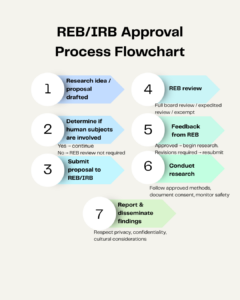
Research ethics boards (REBs) or institutional review boards (IRBs) are tasked with ensuring that the rights and welfare of human and non-human animal research subjects are protected at all institutions, including universities, hospitals, nonprofit research institutions, and other organizations, that receive federal research support. REBs typically consist of members from a variety of disciplines, such as sociology, economics, education, social work, and communications, to name a few. Most REBs also include representatives from the community in which they reside. For example, representatives from nearby prisons, hospitals, or treatment centres might sit on the REBs of nearby university campuses. The diversity of membership helps to ensure that the many and complex ethical issues that may arise from human and non-human animal research will be considered fully by a knowledgeable and experienced panel. Investigators researching human subjects are required to submit proposals outlining their research plans to REBs for review and approval before beginning their research. Even students who research human subjects must have their proposed work reviewed and approved by the REB before beginning any research—although on some campuses, exceptions are made for classroom projects that will not be shared outside of the classroom.

Given the previous examples of ethical issues in past research discussed earlier in this chapter, it may surprise you to learn that REBs are not always popular or appreciated by researchers. Who would not want to conduct ethical research, you ask? In some cases, the concern is that REBs are most well-versed in reviewing biomedical and experimental research, which is not always the case in nursing research. Some nursing research, especially qualitative research, is open-ended in nature, a fact that can be problematic for REBs. The members of REBs often want to know in advance exactly who will be observed, where, when, and for how long, whether and how participants will be approached, exactly what questions they will be asked, and what predictions the researcher has for their findings. Providing this level of detail for a yearlong participant observation within an activist group of 200-plus members, for example, would be extraordinarily frustrating for the researcher in the best case and most likely impossible. Of course, REBs do not intend to have researchers avoid studying controversial topics or avoid using certain methodologically sound data-collection techniques, but unfortunately, that is sometimes the result. The solution is not to eliminate review boards, which serve a necessary and important function, but instead to help educate REB members about the variety of nursing and social scientific research methods and topics they may encounter.
Remixed from:
- An Introduction to Research Methods in Sociology, by Valerie A. Sheppard (2019) published under a CC BY-NC-SA 4.0 license.
Media Attributions
- Scale of justice vector is by user_255149 on All-free-download.com, and is free for non-commercial use only with attribution (All-free-download.com Vector images license)
- Figure 3.3 Research studies involving humans must be reviewed by a Research Ethics Board (REB) is by Ime Stavinga/TRU Open Press and is subject to the CC BY-NC-SA 4.0 license.
- Figure 3.4 by Florriann Fehr & Katie Gregson/TRU Open Press on Canva and is subject to the Canva Content License.
References
Sheppard, V. A. (2019). Chapter 11. Institutional Research Review Boards (IRBs). In An introduction to Research Methods in Sociology. Justice Institute of British Columbia. BCcampus. https://pressbooks.bccampus.ca/researchmethods/
user_255149. (n.d.). Scale of justice vector [image]. All-free-download.com. https://all-free-download.com/free-vector/download/scale_of_justice_vector_6843643.html
A committee in Canada responsible for reviewing and approving research involving human participants to ensure it meets the ethical principles outlined in the Tri-Council Policy Statement (TCPS2). REBs function similarly to IRBs but operate under Canadian guidelines emphasizing respect for persons, concern for welfare, and justice. They provide ethical oversight and monitoring for research conducted at Canadian institutions.
A committee in the United States that reviews, approves, and monitors research involving human participants to ensure compliance with federal regulations and ethical standards. IRBs operate under U.S. regulations such as the Common Rule and are typically associated with universities, hospitals, or federal agencies. Their primary role is to protect the rights, safety, and welfare of human subjects.