
Refining the Research Topic
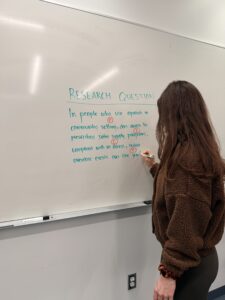
Refining the Research Topic
Remember that a research idea can be generated using rational and/or creative techniques. However, at the onset, the developed idea may be too broad or too specific and may need to be refined. Refining a research idea involves the steps outlined in Figure 5.3. First, a research topic is picked, and the topic is tested by reading the literature. If the topic is too broad, it needs to be made more focused, and if it is too specific, it needs to be broadened. The literature search and discussion with subject experts could be useful in refining the topic.

A useful way of refining the research idea/topic is to use a concept map based on the findings from the literature or discussions to identify contextual factors or areas related to the topic. Let us return to our previous example of obesity as your research topic which was depicted in the video. A concept map that utilized the 5Ws and H (who, what, where, when, why and how) questions is presented in Figure 5.4 to facilitate in-depth analysis and refinement of the research topic. It is important to note that concept maps can be complex as each theme can be branched into further subthemes.

The refined topic can be further tested by searching the literature to ensure that the idea is novel and has not been previously answered. The Delphi technique is an alternative technique that could also be used to refine the topic and generate possible research questions. The Delphi technique entails selecting a more focused research idea via contributions from a group of people who are either working on or interested in the research topic. The Delphi consists of four distinct phases. In the first phase, participants can provide whatever information they deem pertinent, which explores the topic under investigation. The second stage is ascertaining how the entire group perceives the topic/idea. The third step is utilized to investigate any substantial disputes and identify the root causes of any identified differences. A final assessment of all the information acquired is done in the fourth step.
Develop and Revise Questions that Focus Your Inquiry
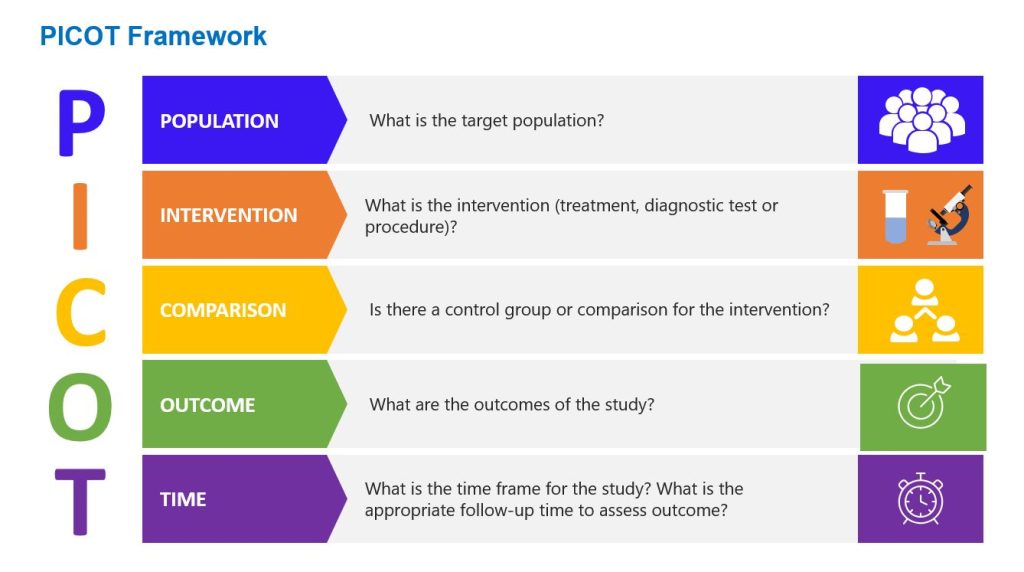
Once the research topic has been decided, the next step is to formulate the research question(s). The research question highlights the issue that has to be investigated and directs the methodology. It also results in the development of a testable and appropriate hypothesis. It is thought that high-quality research results from well-crafted research questions. Coming up with good research questions is something that most novice researchers find challenging. A valid tool that is useful in formulating a good research question is the PICOT framework which is commonly used in quantitative research. To use this framework, you need to consider the population of interest (P), the intervention (I) under investigation, the control or comparison group (C), the outcome (O), and the time frame (T) during which the study will take place (see Figure 5.5).
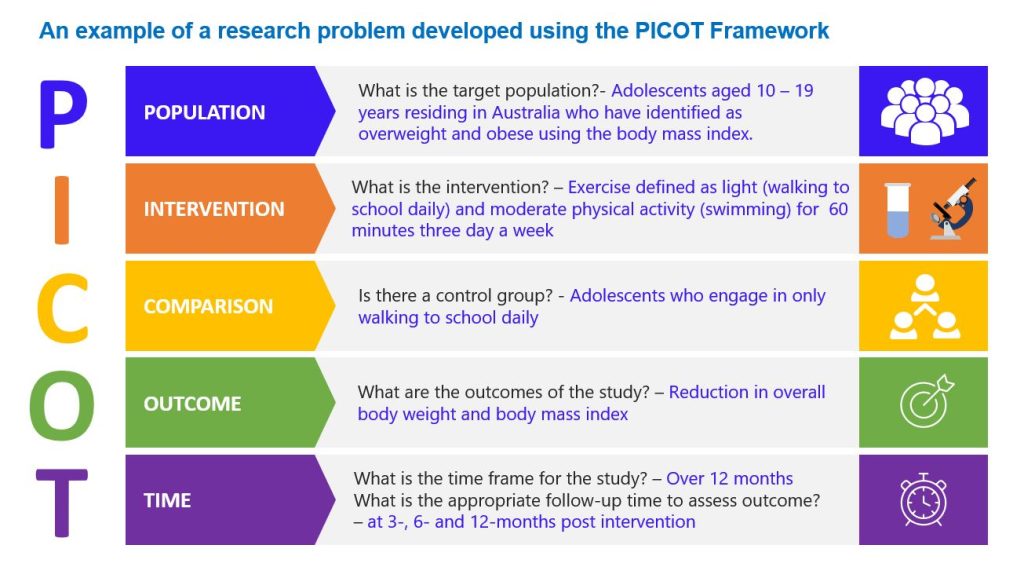
In addition, the framework is valuable when developing and stating a research hypothesis driven by the research question. A hypothesis is a foundation and logical construct between a research problem and its solution, and it expresses a possible answer to a research question. The research question serves as the basis for the development of the research hypothesis, which is then summarized in a way that establishes the basis for testing, statistical analysis, and, ultimately, the significance of the study. A good hypothesis is usually founded on a good research question. There are two types of research hypotheses – conceptual research hypothesis and operational research hypothesis. The conceptual research hypothesis is a broad or general statement about a research problem, while the operational hypothesis is a more specific statement that provides a detailed description of how the variables in the study will be measured, and predicts how they will be related to one another. Thus, the operational hypothesis is a testable statement that is derived from the conceptual hypothesis. The example below in Figure 5.6 and Box 5.1 shows how the PICOT framework is used to develop a research question and hypotheses.
| Research Question |
| Is frequent and regular exercise associated with a decrease in body weight and body mass index among overweight and obese Australian adolescents? |
| Conceptual Hypothesis |
| Frequent and regular exercise reduces obesity in Australian adolescents |
| Operational Hypothesis |
| Frequent and regular exercise, defined as light exercise ( walking to school daily) and moderate exercise (swimming for 60 minutes three days a week), will reduce overall body weight measured in kilograms and body mass index in overweight and obese Australian adolescents aged 10 to 19 years compared to only light exercise (walking to school) only. |
Quick Activity: Find the PICOT
Read the sample research question below. Underline or highlight the P, I, C, O, and T.
Example Question:
In nursing students (), does participation in virtual simulation labs () compared with traditional classroom teaching () improve clinical competence scores () over one semester (___)?
- P = Population
- I = Intervention/Interest
- C = Comparison
- O = Outcome
- T = Timeframe
Answer to the above: In nursing students (P), does participation in virtual simulation labs (I) compared with traditional classroom teaching (C) improve clinical competence scores (O) over one semester (T)?
Dr. Fehr’s FINER Checklist for Nursing Research Questions 
Use this checklist to test your research idea before moving forward.
F – Feasible
- Can I complete this project with the time I have (e.g., within a semester)?
- Do I have the skills or support to carry it out?
- Do I have access to the people, data, or setting I want to study?
I – Interesting
- Am I genuinely curious about this question?
- Would other nursing students, instructors, or clinicians care about the answer?
N – Novel
- Does my question add something new (different population, setting, or method)?
- Have I checked the literature to see what’s already known?
E – Ethical
- Can I protect participants’ confidentiality, dignity, and safety?
- Would my project be approved by a Research Ethics Board (REB/IRB)?
R – Relevant
- Will the results help nurses improve patient care or nursing education?
- Could this information guide practice, policy, or future research?
👉 Quick Student Tip: If you can’t check off most of these boxes, don’t worry—just refine your question! Narrow the scope, adjust the population, or simplify the design until it’s doable.
Characteristics of a Good Research Question
A good research question has the following qualities: it is Feasible, Interesting, Novel, Ethical, and Relevant (FINER). Once you have selected your topic area and reviewed literature related to it, you may need to narrow it down to something that can be realistically researched and answered. In the last section, we learned about asking who, what, when, where, why, and how questions. As you read more about your topic area, the focus of your inquiry should become more specific and clearer. As a result, you might begin to ask questions that describe a phenomenon, compare one phenomenon with another, or probe the relationship between two concepts.
You might begin by asking a series of PICO questions. Although the PICO method is used primarily in the health sciences, it can also be useful for narrowing/refining a research question in the social sciences. A way to formulate an answerable question using the PICO model could look something like this:
Patient, population or problem: What are the characteristics of the patient or population? (e.g., gender, age, other demographics) What is the social problem or diagnosis you are interested in? (e.g., poverty or substance use disorder)
Intervention or exposure: What do you want to do with the patient, person, or population (e.g., treat, diagnose, observe)? For example, you may want to observe a client’s behavior or a reaction to a specific type of treatment.
Comparison: What is the alternative to the intervention? (e.g., other therapeutic interventions, programs, or policies) For example, how does a sample group that is assigned to mandatory rehabilitation compare to a sample group assigned to an intervention that builds motivation to enter treatment voluntarily?
Outcome: What are the relevant outcomes? (e.g., academic achievement, healthy relationships, shame) For example, how does recognizing triggers for trauma flashbacks impact the target population?
Example of PICOT Method
Topic: high burnout among nurses working long shifts
- PICOT: In acute care settings with nurses working 12 hour shifts (P), how does mindfulness-based stress reduction training (I), compared to no stress intervention (C), affect reported burnout levels (O) after 8 weeks (T)?
So, what makes a good research question? First, it is generally written in the form of a question. It would be incorrect say that your research question is “the opiate epidemic,” “animal assisted therapy,” or “oppression.” You need to frame your topic as a question, not a statement. A good research question is also one that is well-focused. A well-focused question helps you tune-in to only the relevant information about your topic and prevents you from attempting to answer everything about the world all at once. You could be the most eloquent writer in your class, but if your research question is unclear, your work will ultimately fall flat.
In addition to being written in the form of a question and being well-focused, a good research question is one that cannot be answered with a simple yes or no. For example, if your interest is in gender norms, you could ask, “Does gender affect a person’s performance of household tasks?” but you will have nothing left to say once you discover your yes or no answer. Instead, you could ask about the relationship between gender and household tasks. Alternatively, maybe we are interested in how or to what extent gender affects a person’s contributions to housework in a marriage. By tweaking your question in this small way, you suddenly have a much more fascinating question and more to say as you attempt to answer it.
In sum, a good research question generally has the following features:
-
- It is written in the form of a question
- It is clearly written
- It is not answerable with a simple “yes” or “no”
- It has more than one plausible answer
- It considers relationships among multiple variables
- It is specific and clear about the concepts it addresses
- It contains a target population
Remixed from:
- Scientific Inquiry in Social Work by Matthew DeCarlo (2018) published by pressbooks under a CC BY-NC-SA license.
- An Introduction to Research Methods for Undergraduate Health Profession Student by Faith Alele and Bunmi Malau-Aduli (2023) published by pressbooks under a CC BY-NC-SA license.
Media Attribution
- Dr. Fehr avatar by Research Assistant Katie Gregson on Canva using Canva AI image creation https://www.canva.com/ai-assistant/ is subject to the Canva Pro Content License.
- Figure 5.2 A well-constructed research question guides the entire study process is by Resarch Assistant Ime Stavinga and is subject to the CC BY-NC-SA 4.0 license.
References
Alele, F., Malau-Aduli, B. (2023). Chapter 2: “Planning a research project.” In An Introduction to Research Methods for Undergraduate Health Profession Students. James Cook University. https://jcu.pressbooks.pub/intro-res-methods-health/part/2-planning-a-research-project/
DeCarlo, M. (2018). Chapter 3.3: “Refining your question”. In Scientific Inquiry in Social Work. Pressbooks. https://pressbooks.pub/scientificinquiryinsocialwork/chapter/3-3-refining-your-question/
DeCarlo, M. (2018). Chapter 8: “Creating and refining your question”. In Scientific Inquiry in Social Work. Pressbooks. https://pressbooks.pub/scientificinquiryinsocialwork/chapter/8-0-chapter-introduction/