
Levels of Abstraction

To guide the research process, we can use the ladder of abstraction to help formulate research questions. We start at the top of the ladder with an abstract concept and move down the ladder to determine how to define the concept in a way that can be studied. Using this ladder, students can see how abstract ideas are operationalized into measured variables.
From Abstract to Concrete
From most abstract to most concrete, the steps are worldviews, frameworks, theories, concepts and variables. This approach can be applied by first choosing a worldview, then selecting a theoretical framework, using theories to develop a hypothesis, defining key concepts, and finally identifying variables and collecting data (the most concrete step).
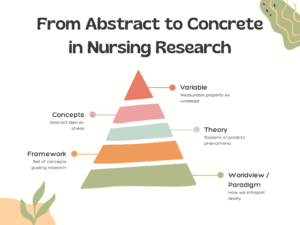
From Concrete to Abstract
Although we typically move down the ladder of abstraction—from broad, theoretical ideas to concrete variables we can measure—it’s also helpful to view the ladder in reverse. After identifying measurable variables, we can move back up the ladder to see how those concrete elements connect to larger concepts, theories, frameworks, and worldviews. In this way, the ladder of abstraction becomes a practical tool rather than just a visual metaphor: it illustrates how research moves fluidly between the abstract and the concrete. This bidirectional perspective shows how broad ideas take shape as measurable components and how those components, in turn, support the larger structure of research design.
The following Key Terms demonstrates the progression from concrete observations to more abstract concepts in research, helping students understand how ideas, variables, and frameworks interrelate.
Key Terms
- Variables: A property being studied. Something that changes or varies. A researcher studies one variable and how it relates to another
For example: When watering flowers-> the independent variable would be the volume of water (cause) and the dependent variable would be the days to flowering (effect). - Concepts: Mid-level abstractions; An idea, mental image, or symbol of an abstract idea (i.e., pain, stigma).
- Theories: A set of interrelated concepts that serve the purpose of explaining or predicting phenomena.
- Hypothesis: A micro-theory; a best guess or prediction about what one expects to find about the variable outlined in the study.
- Framework: A set of ideas that guide research; it identifies keys concepts and shows specific relationships between concepts.
- Worldview (AKA paradigm): The way people think about the world and interpret reality.
Example Using the Ladder of Abstraction: Stress Research
This example demonstrates how the ladder of abstraction can be applied in a real research scenario. By starting with a broad worldview and moving step by step toward measurable variables, researchers can systematically design a study. In this case, we explore stress research, showing how abstract ideas like stress and coping are narrowed into specific concepts and measurable variables that can be studied in practice.
- Worldview: Post-positivist
- Framework: Stress & Coping Framework
- Theory: Lazarus’ Stress & Coping Theory
- Concept: Stress, coping strategies, academic workload
- Variable: Independent = workload; Dependent = perceived stress score
Activity
Now challenge yourself to fill out the ladder of abstraction like the example above using the topic: Hand Hygiene Compliance Among Hospital Staff.
References
Fehr, F. (2025). Introduction to research language [PowerPoint Slides]. 11263: NURS 2300, Thompson Rivers University.
Haber, J., Cameron, C., Singh, M. D., & Lobiondo-Wood, G. (2022). Nursing research in Canada : Methods, critical appraisal, and utilization (5th ed., p. 21.). Elsevier Canada.
TRU Open Press. (2025). Woman writing research terms on a whiteboard [AI-generated image]. OpenArt. https://openart.ai/
Media Attribution
- Woman writing research terms on a whiteboard [AI-generated image] was created by OpenArt AI and is used under a CC BY 4.0. license.
- Figure 2.2 From Abstract to Concrete in Nursing Research has been adapted from Haber et al. (2022, p.21) and is used under Fair Dealing for non-commercial and educational purposes. Made by Katie Gregson on Canva subject to Canva Content License.
The range from very concrete, specific ideas (such as observable patient behaviours or measurable clinical variables) to more abstract, theoretical ideas (such as concepts like “caring,” “coping,” or “health”). Researchers move up and down this “ladder” to connect real-world observations to broader theories and to ensure their concepts, variables, and interpretations are aligned and meaningful.
Something that is intangible or theoretical and not directly observable. Feelings, ideas, or concepts. For example: anxiety, health, quality of life.
Something that is tangible and specific. Can be observed or measured directly. For example: a stethoscope, heart rate.
A property being studied. Something that changes or varies. A researcher studies one variable and how it relates to another
For example: When watering flowers, the independent variable would be the volume of water (cause) and the dependent variable would be the days to flowering (effect).
Mid-level abstractions; An idea, mental image, or symbol of an abstract idea (i.e., pain, stigma).
A set of interrelated concepts that serve the purpose of explaining or predicting phenomena.
A micro-theory; a best guess or prediction about what one expects to find about the variable outlined in the study.
A framework is a structured set of concepts or principles that guides the design, data collection, and analysis of a study. It provides a conceptual foundation that connects theories to the research question and helps ensure the study is coherent, focused, and aligned with its underlying assumptions.
The way people think about the world and interpret reality.
A research worldview that assumes reality exists but can never be fully known. Knowledge is considered approximate, and researchers use systematic, evidence-based methods to develop explanations while recognizing their own assumptions and the limitations of their findings.