
Types of Literature Reviews
A literature review is a critical analysis and synthesis of existing research on a specific topic or question. In nursing and other health disciplines, literature reviews help researchers understand what is already known, identify gaps, and determine how new research can contribute to practice. Literature reviews fall into several broad “families,” including traditional reviews, systematic reviews, reviews of reviews, rapid reviews, qualitative systematic reviews, mixed-methods reviews, and purpose-specific reviews.
Traditional Reviews
Traditional literature reviews summarize and critique existing studies to draw conclusions about a topic. Examples include narrative reviews, integrative reviews, critical reviews, and state-of-the-art reviews. Although these reviews are useful for providing broad overviews, they often lack clear criteria for selecting studies and do not follow a standardized or systematic process. This limitation has led to increased emphasis on more rigorous, transparent review methods.
Systematic Reviews
Systematic reviews use a structured, reproducible methodology to search for, appraise, and synthesize research evidence. They often focus on a specific study design, such as randomized controlled trials or observational studies. Systematic reviews require comprehensive database searches, predefined inclusion criteria, and strict methodological guidelines. Tools such as the Cochrane Handbook and reporting frameworks like PRISMA support their development. A meta-analysis—commonly part of systematic reviews—statistically combines quantitative findings to produce a pooled estimate of effect.
Review of Reviews
This review family synthesizes evidence from existing systematic reviews rather than from primary studies. Using consistent, high-quality methods, review-of-reviews approaches rely heavily on databases such as the Cochrane Library or PROSPERO (where systematic review protocols may be registered). These reviews follow standards similar to systematic reviews but operate at a higher level of evidence synthesis.
Qualitative Reviews
Qualitative evidence syntheses gather and interpret findings from primary qualitative studies. While methods are newer compared to quantitative systematic reviews, they continue to evolve through guidance from organizations such as the Cochrane Qualitative and Implementation Methods Group. Qualitative reviews may be aggregative (summarizing data, such as in meta-aggregation) or interpretive, generating new conceptual understandings (as in meta-ethnography or meta-narrative reviews). These reviews are valuable for exploring lived experiences, cultural perspectives, and complex clinical phenomena.
Mixed-Methods Reviews
Mixed-methods reviews integrate both quantitative and qualitative evidence to provide a comprehensive understanding of whether an intervention works, how it works, and under what conditions. These reviews support evidence-based nursing by combining numerical data with contextual insights. Examples include realist synthesis, narrative synthesis, and critical interpretive synthesis.
Purpose-Specific Reviews
Purpose-specific reviews are tailored to meet the needs of a particular research goal. They include scoping reviews, concept analyses, mapping reviews, and methodology reviews. These reviews are especially useful in nursing when researchers need to clarify definitions, map emerging fields, or understand how concepts have evolved in healthcare literature.
Exploring Research Reviews and PRISMA
For students interested in learning more about research reviews and systematic approaches, the table below summarizes different review types, their purposes, and key methods. This material is especially useful for students pursuing research grants beyond a regular undergraduate research class, working on a research team, or at the master’s level, as it provides a deeper understanding of evidence synthesis. The section also introduces PRISMA (Preferred Reporting Items for Systematic Reviews and Meta-Analyses), an open-access guideline for transparent and reproducible reporting. PRISMA includes a checklist and flow diagram, which students can view or download directly. This supplemental material is optional but recommended for students who want to expand their research skills beyond the general literature review assignment.
Literature Review Types
Several types of literature reviews are used in nursing and health research, each with a different purpose. Table 6.1 below summarizes the main literature review types commonly used in nursing and health disciplines. It is organized by review family and includes purpose, method, strengths, limitations, and recommended guidelines for further reading.
|
Family |
Review Type |
Purpose |
Method |
Strengths |
Limitations |
Guidelines / References |
|
Traditional Reviews |
Narrative Review |
Broad overview of a topic |
Qualitative summary; no strict inclusion criteria |
Provides context and theory; easy to read |
Subjective; not systematic |
Grant & Booth (2009): https://doi.org/10.1080/14616700902851304 |
|
Traditional Reviews |
Integrative Review |
Combines experimental & non-experimental studies |
Includes qualitative, quantitative, theoretical literature |
Generates new frameworks; broad perspective |
Complex; synthesis may be difficult |
Whittemore & Knafl (2005): https://doi.org/10.1177/0193945905276467 |
|
Traditional Reviews |
Critical Review |
Evaluates state of knowledge critically |
Interpretive summary of literature |
Identifies gaps; deep insights |
Highly subjective |
Grant & Booth (2009): https://doi.org/10.1080/14616700902851304 |
|
Systematic Reviews |
Systematic Review |
Answer a specific research question rigorously |
Structured, reproducible search; inclusion/exclusion criteria |
Transparent; reproducible; reliable |
Time-consuming |
PRISMA: https://www.prisma-statement.org/prisma-2020-checklist |
|
Systematic Reviews |
Meta-Analysis |
Combine quantitative results from studies |
Statistical synthesis |
Precise estimates; identifies patterns |
Requires similar studies; publication bias |
Cochrane Handbook: https://training.cochrane.org/handbook |
|
Review of Reviews |
Umbrella Review |
Synthesizes multiple systematic reviews |
Summarizes existing systematic reviews |
High-level synthesis; decision-making |
Dependent on quality of underlying reviews |
Aromataris et al. (2015): https://doi.org/10.1111/jebm.12136 |
|
Purpose-Specific Reviews |
Scoping Review |
Map extent and nature of research |
Broader inclusion criteria; descriptive synthesis |
Identifies gaps; guides research |
Usually does not assess quality |
JBI Manual: https://jbi-global-wiki.refined.site/space/MANUAL/PRISMA-ScR |
|
Purpose-Specific Reviews |
Rapid Review |
Timely evidence synthesis |
Streamlined systematic review |
Fast; practical |
May sacrifice rigor |
Khangura et al. (2012): https://doi.org/10.1186/1471-2288-12-15 |
|
Qualitative Reviews |
Meta-Ethnography / Meta-Synthesis |
Interpretive synthesis of qualitative studies |
Aggregative or interpretive synthesis |
Explores lived experiences; cultural perspectives |
Methods newer; less standardized |
Cochrane Qualitative Methods Group |
|
Mixed-Methods Reviews |
Mixed-Methods Review |
Integrates qualitative & quantitative findings |
Combines numeric data with contextual insights |
Comprehensive understanding of interventions |
Complex; requires expertise |
Realist & Narrative Synthesis guidance |
|
Purpose-Specific Reviews |
Concept / Mapping / Methodology Review |
Clarify definitions, map fields, or analyze methodology |
Targeted search and synthesis |
Helps emerging topics or clarify concepts |
Narrow focus; may miss broader context |
JBI Manual |
Literature reviews can be grouped into families based on purpose and method. Traditional reviews (narrative, integrative, critical) provide broad overviews and critique. Systematic reviews and meta-analyses rigorously answer specific questions. Review-of-reviews approaches (umbrella reviews) summarize multiple systematic reviews. Qualitative and mixed-methods reviews explore experiences or integrate different types of evidence. Purpose-specific reviews (scoping, mapping, concept, methodology) clarify definitions, map research gaps, or provide rapid evidence. Students can use this table to compare review types and identify which approach is best suited for their research or evidence-based practice needs.
PRISMA Guidance
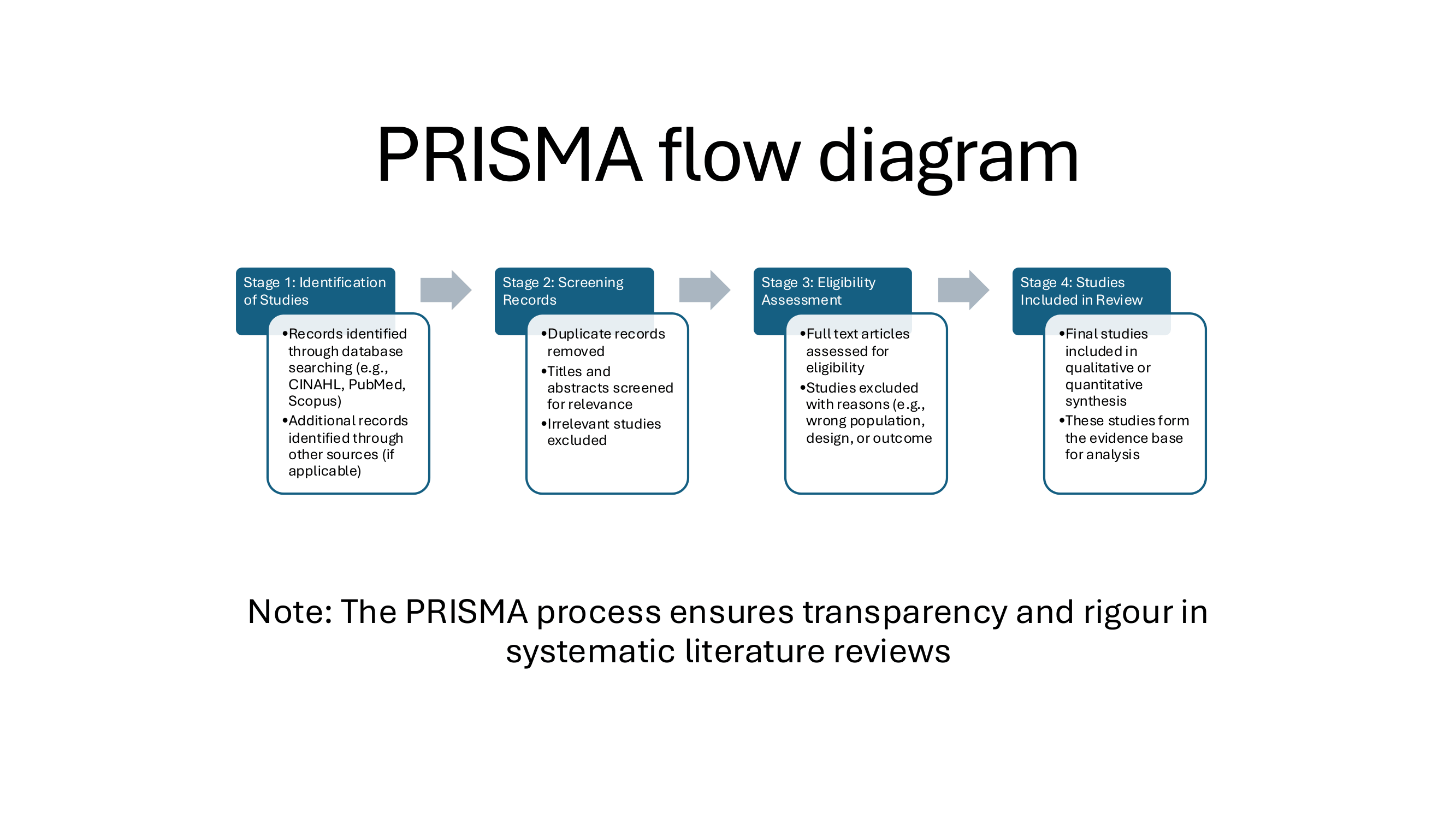
PRISMA (Preferred Reporting Items for Systematic Reviews and Meta-Analyses) is a widely used reporting guideline that ensures systematic reviews and meta-analyses are conducted and reported transparently. It includes a checklist (27 items covering all sections of a review) and a flow diagram showing how studies were identified, screened, and included. For scoping reviews, the PRISMA-ScR extension provides a tailored checklist and flow diagram to report mapping of evidence rather than critical appraisal.
Key Points:
- PRISMA improves transparency, reproducibility, and credibility.
- PRISMA-ScR is used specifically for scoping reviews.
- Both checklist and flow diagram are open-access under Creative Commons Attribution 4.0 license.
Open-Access Templates:
- PRISMA 2020 Checklist: https://www.prisma-statement.org/prisma-2020-checklist
- PRISMA 2020 Flow Diagram: https://www.prisma-statement.org/prisma-2020-flow-diagram
- PRISMA-ScR Checklist and Flow Diagram (for scoping reviews): https://jbi-global-wiki.refined.site/space/MANUAL/PRISMA-ScR
Use PRISMA or PRISMA-ScR to structure your systematic or scoping review reports, ensuring clarity, transparency, and reproducibility. Include the flow diagram in assignments or publications to visually document study selection.
Remixed from:
- An Introduction to Research Methods for Undergraduate Health Profession Students by Bunmi Malau-Aduli and Faith Alele (2023), published under a CC BY NC 4.0 license.
Media Attributions
- Dr. Fehr [avatar] by Research Assistant Katie Gregson on Canva using Canva AI image creation https://www.canva.com/ai-assistant/ is subject to the Canva Pro Content License.
- Figure 6.2 is by Dr. Florriann Fehr and is subject to the CC BY-NC-SA 4.0 license.
References
Alele, F., & Malau-Aduli, B. (2023). 2.5 Reviewing the literature. An Introduction to Research Methods for Undergraduate Health Profession Students. https://jcu.pressbooks.pub/intro-res-methods-health/chapter/2-5-reviewing-the-literature/
Fink, A. (2019). Conducting research literature reviews: From the Internet to Paper. SAGE Publications, Incorporated.
PRISMA. (2020). PRISMA 2020. PRISMA Statement. https://www.prisma-statement.org/prisma-2020