
Qualitative, Quantitative and Mixed Method Research
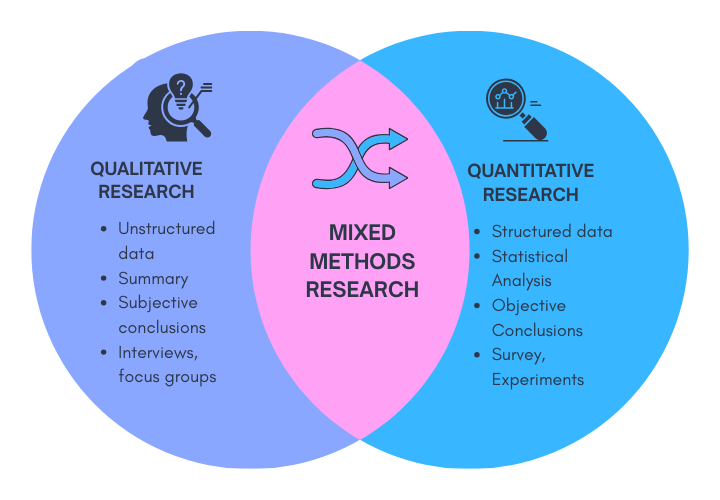
Research can be either qualitative, quantitative, or mixed methods. Mixed methods research is a combination of qualitative and quantitative research. It is important to recognize and understand the differences between these research methods as a nurse researcher because choosing the right approach ensures your study answers the appropriate research questions and helps you critically appraise relevant evidence for practice. We will explore these research methods in more depth in Chapters 7 and 8.
Qualitative Research
Qualitative research answers the “why” questions. It explores personal meanings, values, experiences, human patterns, perceptions, and processes. The types of data include words, text, observations, and symbols, and the methods commonly used are interviews, focus groups, photo voice, and participant observation. For example, a researcher may explore: “How do newly graduated nurses experience the transition from student to professional practice in acute care settings?”
Quantitative Research
Quantitative research answers “how many” or “how much” questions. It tests hypotheses, examines relationships, assesses differences, and explains cause-and-effect interactions among the variables being studied. Quantitative data include numbers and statistical analysis. Common methods include surveys, questionnaires, cross-sectional studies, controlled experiments, and clinical trials. For example, a researcher might ask: “What is the effectiveness of hand hygiene education for residents in reducing the incidence of healthcare-associated infections (HAIs) in a long-term care facility over a three-month period?”
Mixed Methods
Mixed Methods research is widely used by nurses and interdisciplinary teams. It uses both quantitative and qualitative methods and is often applied in program evaluations, organizational studies, and policy development. Mixed methods research is a form of triangulation. For example, a researcher might ask: “How does participation in a peer-support program affect the stress levels and coping strategies of new nurses during their first six months of practice?”
| Characteristic | Qualitative | Quantitative | Mixed methods |
|---|---|---|---|
| Data | Images, words, patterns, categories | Variables | Combination of variables, images, words |
| Data analysis | Search for patterns and themes | Statistical relationships | Qualitative support and quantitative indicators |
| Results | Verified findings may be generalizable | Generalizable | Contextualized findings representing insider perspectives |
| Final report form | Narrative with direct quotes from participants | Statistical report | Eclectic and pragmatic |
Quantitative, Quantitative, & Mixed Methods Research Approaches
Generally speaking, qualitative and quantitative approaches are the most common research methods. While these two approaches are often presented as a dichotomy, in reality, the distinction is more complicated. Although some researchers strongly align with either quantitative or qualitative research, many recognize the advantages of combining both through mixed methods research. The following sections provide a deeper look at each approach. Table 4.3 summarizes the key differences between quantitative and qualitative approaches.
Quantitative Research Approaches
A quantitative approach to research is probably the most familiar approach for introductory research students. Originating from the natural sciences (e.g., chemistry and biology), this approach is grounded in the belief that there is one reality or truth that can be discovered (a perspective known as realism). Therefore, asking the “right” questions is key. This perspective favours observable causes and effects and is outcome-oriented. Researchers typically use aggregate data to identify patterns and uncover the “truth” about a phenomenon. True understanding is achieved through prediction and measurement.
Qualitative Research Approaches
In contrast, qualitative research is often viewed as the opposite of quantitative research. Qualitative researchers are phenomenologists or human-centered researchers who account for participants’ thoughts, feelings, and lived experiences. Instead of assuming one objective truth, qualitative researchers adopt a constructionist perspective, which holds that knowledge is created, not discovered, and that multiple realities exist depending on perspective.
Researchers seek to understand why, how, and for whom a phenomenon occurs—often exploring experiences that cannot be directly observed. Importantly, qualitative researchers recognize that no researcher is a completely neutral or objective outsider. This approach is process-oriented, and true understanding arises from interpreting the meaning behind actions and experiences, rather than predicting outcomes.
| Quantitative Research | Qualitative Research |
| Tests hypotheses that the researcher generates. | Discovers and encapsulates meanings as the researcher becomes immersed in the data. |
| Concepts are in the form of distinct variables. | Concepts appear as themes, motifs, generalizations, and taxonomies; the objective is to generate concepts and meaning. |
| Measures are systematically created before data collection and are standardized as far as possible. E.g., measures of job satisfaction. | Measures are often flexible and may be more specific to the individual setting or researcher. E.g., a specific scheme of values. |
| Data are in the form of numbers (numeric) from precise measurement. | Data are in the form of words from documents (textual), observations (observational), and transcripts (descriptive); however, quantification may still be used. |
| Theory is largely causal and deductive. | Theory can be causal or non-causal and is often inductive and interpretive. |
| Procedures are standardized, and replication is assumed. | Procedures are particular (context-specific) and replication may be difficult. |
| Analysis relies on statistics, tables, or charts, and relates to hypotheses. | Analysis focusses on extracting themes or generalizations from evidence and organizing data into a coherent, consistent picture; these generalizations can then be used to generate hypotheses. |
Mixed-Method Research Approaches
Increasingly, researchers use a mixed methods approach to gain a more comprehensive understanding of complex problems. Mixed methods research focuses on integrating both quantitative and qualitative approaches to address research questions that require:
- Examination of real-life contexts, multi-level perspectives, and cultural influences
- Rigorous quantitative analysis of magnitude and frequency, alongside qualitative exploration of meaning and context
- Development of a holistic interpretive framework that integrates diverse data sources (Adjei, n.d., as cited in Sheppard, 2019)
Researchers who favor mixed methods believe this approach offers a balanced and comprehensive way to uncover “the truth” or at least “a truth.” Although some critics argue that mixing fundamentally different paradigms may create conflict, many highly respected social science studies have successfully combined both approaches and demonstrated the effectiveness of this integration.
Using multiple research strategies to understand a phenomenon is called triangulation. Other forms of triangulation include:
- Triangulation of measures – using multiple approaches, tools or techniques to measure the same variable
- Triangulation of theories – applying multiple theoretical perspectives to explain a single event or phenomenon.
Remixed from:
- An Introduction to Research Methods in Sociology by Valerie A. Sheppard (2019), published by BCcampus under a CC BY-NC-SA 4.0 license.
References
Sheppard, V. A. (2019). Chapter 19: “Quantitative, Quantitative, & Mixed Methods Research Approaches”. In An introduction to research methods in sociology. BCcampus. https://pressbooks.bccampus.ca/researchmethodsinsociology
Media Attributions
- Research Methods Venn Diagram was created by TRU Open Press using Canva, and can be used under a CC BY 4.0 license.
A research approach that explores experiences, meanings, and perspectives through non-numerical data, such as interviews, observations, or text, to understand why or how phenomena occur.
A research approach that collects and analyzes numerical data to measure variables, test hypotheses, and identify patterns or relationships, focusing on how much or how often.
A research approach that combines both qualitative and quantitative methods in a single study to provide a more comprehensive understanding of a research question.
The specific research tool used to collect data (e.g., survey, interview, focus groups).
Small group comes together to discuss a topic guided by a moderator. Exploratory and interactive.
Participatory qualitative research method where participants take photographs to capture and share experiences or perspectives and the photos start discussion.
Researcher becomes a participant to gain insight into a community's perspective and observes behaviours, dynamics, and interactions.
Observational research design that analyzes data from a population at one specific point in time
Infections that patients acquire while receiving care in a healthcare setting, such as hospitals or clinics, which were not present or incubating at the time of admission.
Research strategy that involves using multiple methods, data sources, theories, or investigators to study the same thing. The purpose is to try to increase the credibility and validity of the research findings by cross-verifying the findings.
A division or contrast between two things that are presented as completely opposite or mutually exclusive
Fields of study that investigate the natural world, including physical, chemical, and biological phenomena, using observation, experimentation, and evidence-based methods.
Realism is a research paradigm that assumes there is a real, objective world that exists independently of human perception, but our understanding of it is always partial and influenced by how we observe and interpret it
Someone who believes knowledge and meaning are actively created by people through social interactions and experiences, rather than discovered as objective truths.
The use of different measurement approaches to assess the same concept and increase confidence in the findings.
The use of more than one theory to analyze and understand research findings.