
Choosing a Research Topic
Many researchers assume that choosing a topic is a linear process; however, in reality, it is more complex, and the research idea may need to be refined before the topic is finally chosen.
Activity
Watch the video, Choosing a Research Idea [1:28] by Bunmi Malau Aduli and Faith Alele in An Introduction to Research Methods for Undergraduate Health Profession Students (2023) used under a CC BY NC ND 4.0 licence .
 Note: If you are using a printed copy of this resource, watch the video by scanning the QR code with your mobile device.
Techniques for finding and choosing a research topic
There are two main approaches to finding and choosing a research topic– rational (logical) and creative (intuitive). The creative approach requires techniques such as brainstorming, keeping a record of the ideas, using relevance trees and exploring personal preferences. The rational approach, on the other hand, involves techniques such as reviewing the literature to identify knowledge gaps, discussing the ideas with subject experts, peers or stakeholders, using past project titles, scanning the media and identifying one’s strengths and interests. It is also imperative to engage in critical reflection throughout the process to ensure that the topic is relevant. As a result of this process, the topic may not only be refined but may change substantially. It is important to note that diverse techniques can be used simultaneously or iteratively to decide on a research topic. Figure 5.1 portrays the different techniques.
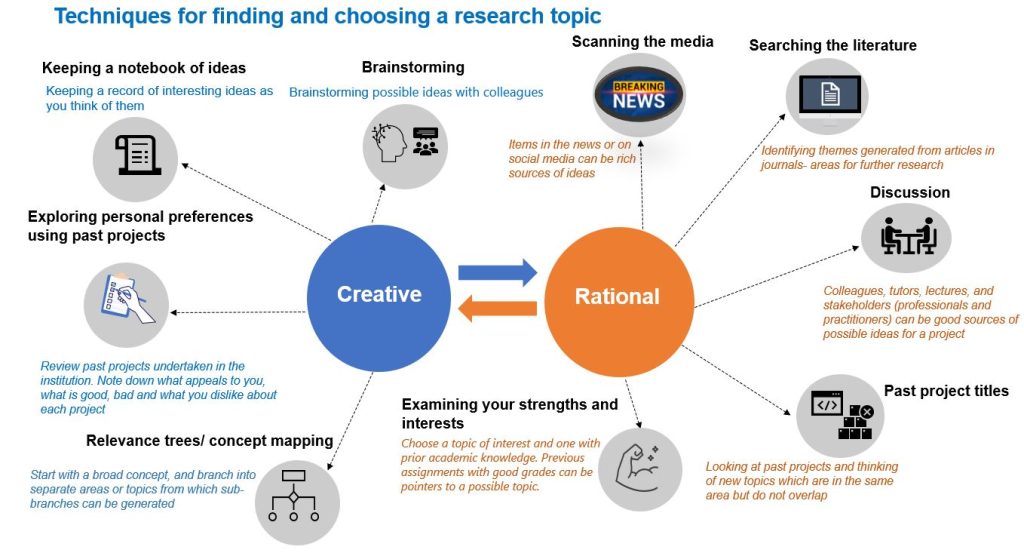
As a researcher, it is important to ensure that your chosen research topic is of obvious value and benefit, financially viable and within your capabilities and interests. As indicated in Table 5.1, ways of assessing your capability include deciding if the topic is achievable within the time frame, whether the project will be current at completion and whether you have access to the required data. Furthermore, there is a need for the topic to be linked to theory, emphasizing the role and importance of literature. This implies that the topic should be set in the context of existing literature, i.e. reading and identifying research already undertaken on that topic to guide the decision-making process about the topic selection. Also, the literature aids the refinement of research ideas and prevents research that repeats what has already been done. The proposed research should provide fresh insight into the topic, the aims and objectives should be clear, and the findings should be of similar value irrespective of the outcome (symmetrical). Finally, the research topic should match the researcher’s career goals. While this may not be the case in all instances, it is important to give it considerable thought, especially for those undertaking a dissertation. A checklist of the attributes of a good research topic is listed in Table 5.1 and serves as a guide when choosing a topic.
Capacity: Is it feasible? |
Appropriateness: Is it worthwhile? |
| Is the topic something the researcher is interested in? | Does the topic fit the specifications set by the examining institution and related to the idea given? |
| Can the researcher develop or obtain the necessary skills within the project time frame? | Is the topic grounded in the literature (linked to theory)? |
| Is the topic achievable in the time available? | Are the research aims and objectives clearly stated? |
| Will the topic/project remain current at the end of the research? | Will the topic provide new insights (originality)? |
| Is the topic/project financially viable? | Is the topic likely to have symmetry of potential outcomes? |
| Will it be easy and feasible to assess and acquire data for the topic? | Does the topic match the researcher’s career goals? |
| Will the topic provide useful knowledge for application in clinical practice |
Activity
Watch this video, Interview with Debra Jordan on Choosing a Research Topic [12:05 min] created by research assistants Katie Gregson and Ime Stavinga (2025). Debra Jordan is faculty here at TRU. With a background in psychiatric nursing, Debra conducted a study in her master’s program to see if Chatgpt could show empathy to simulated patients. She provides insights from her study as well as great tips for students on how to get started in research and how to choose a question of interest.
 Note: If you are using a printed copy of this resource, watch the video by scanning the QR code with your mobile device.
Remixed from:
- An Introduction to Research Methods for Undergraduate Health Profession Students, by Faith Alele and Bunmi Malau-Aduli, published under a CC BY-NC 4.0 license.
References
Alele, F., Malau-Aduli, B. (2023). Chapter 2: “Planning a research project.” In An Introduction to Research Methods for Undergraduate Health Profession Students. James Cook University. https://jcu.pressbooks.pub/intro-res-methods-health/part/2-planning-a-research-project/
Gregson, K. & Stavinga, I. (2025). Interview with Debra Jordan on Choosing a Research Topic [Video]. YouTube. https://youtu.be/wCZ4vBeFTho