
Conclusion
Without seeing the bigger picture, it can be hard to understand at first why frameworks are important. However, frameworks are critical in research and nursing practice because they organize thinking, guide actions, and connect theory to real-world care and outcomes.
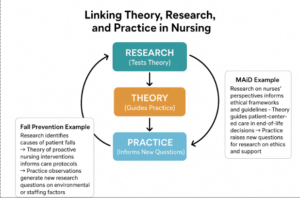
Remember as you move through this content, that theory, research, and practice are interrelated. Research tests theories, and theories emerge from research. Research outcomes inform practice, and practice in turn informs and motivates research. Clinical questions lead to theories that inform clinical practice. Figure 2.3 below shows an example of how all these concepts we have learned in this chapter come together to link theory, research, and practice in nursing.
Scenario
A nurse who is working on a busy hospital unit notices that patient falls are happening more frequently than expected. Concerned for patient safety, the nurse begins talking with colleagues, reviewing patient charts, and observing daily routines. They notice a pattern in that falls often occur during shift changes, when patients try to get out of bed unassisted. Motivated to make a difference, the nurse conducts research to better understand the causes and tests interventions such as extra staff support during high-risk times and bed alarms.
Based on these findings, the nurse helps develop a new theoretical framework showing how proactive nursing interventions—like careful monitoring and timely assistance—can reduce patient falls. This framework not only organizes thinking but also guides research actions and links theory directly to practice. Understanding levels of abstraction, paradigms, and research approaches is essential for conducting competent and meaningful nursing research.
Student Reflection: How might you apply a framework like this in your own practice or research to address a problem you’ve observed
Key Takeaways
- Nursing research is guided by worldviews (paradigms), theories, and frameworks that shape how knowledge is understood and studied.
- A paradigm/worldview reflects beliefs about reality, knowledge, and how research should be conducted (e.g., post-positivist, constructivist, critical).
- Theoretical frameworks provide a structure that guides research questions, design, data collection, and interpretation.
- Knowledge development follows a systematic process: identify a gap → generate knowledge → share → apply → evaluate.
- Research moves along a ladder of abstraction, from broad worldviews to concrete variables that can be measured.
- Key concepts include theory, concepts, variables, ontology, epistemology, methodology, and context, which help define and structure research.
- Inductive reasoning builds theories from data, while deductive reasoning tests existing theories using data.
- Research is often influenced by different paradigms:
- Post-positivism: multiple truths, partial objectivity
- Constructivism: reality is socially constructed
- Critical theory: focuses on power, inequality, and social change
- Frameworks can be conceptual or theoretical, and both help organize and interpret research differently.
- A good framework must be clear, logical, relevant, and supported by literature to ensure strong research design.
- Nursing research begins with real clinical problems and aims to produce evidence that improves patient care and outcomes.
Knowledge Check
Media Attribution
- Figure 2.3 Linking Theory, Research and Practice in Nursing is by Dr. Florriann Fehr/TRU Open Press and is subject to the CC BY-NC-SA 4.0 license.